

Walk up to almost any modern commercial building in Australia, and your phone will show four or five bars. Step inside, take the lift to the third floor, and watch those bars disappear. It is a problem that building owners, developers, and facilities managers face every day, and it is becoming harder to ignore.
The reason is structural. Reinforced concrete, steel framing, energy-efficient glass, and underground car parks all attenuate radio frequency signals. The mobile network outside is working exactly as it should. The building itself is acting as a shield.
For years, the common response was to install a passive Distributed Antenna System or to wait and hope the carriers would expand their indoor coverage. Neither approach works reliably in 2026.
What is a Distributed Antenna System?
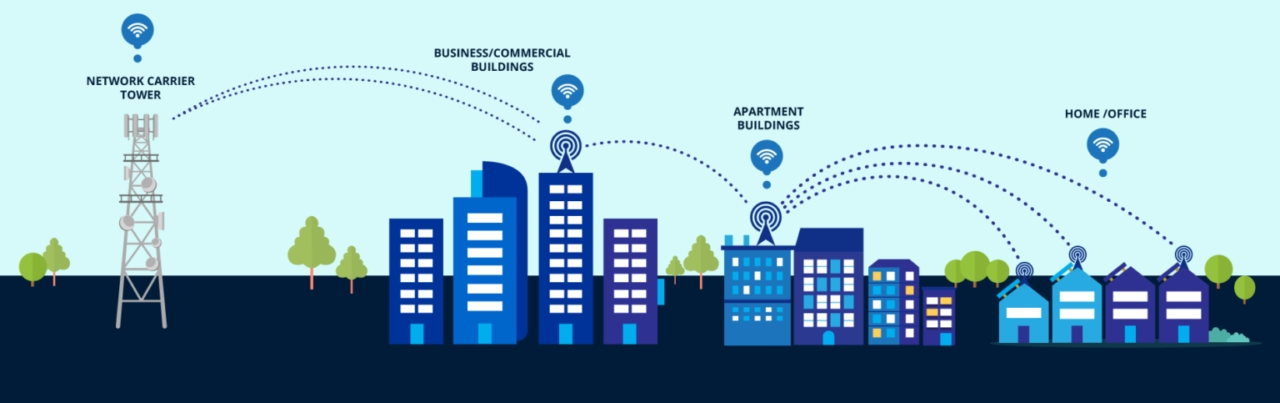
A Distributed Antenna System is a network of antennas installed throughout a building that captures the carrier signal from outside and redistributes it internally. Rather than relying on individual devices to connect directly to a distant cell tower through walls and floors, the building gets its own internal signal infrastructure.
The key distinction in 2026 is between passive and active systems.
A passive DAS uses coaxial cable and passive splitters to distribute a signal from a donor antenna on the roof. It works reasonably well for 4G in smaller buildings. However, passive systems cannot support the higher-frequency bands used by 5G. The physics simply do not allow it. Passive coaxial cable attenuates high-frequency signals too aggressively over distance, meaning a building fitted with a passive DAS today has no practical upgrade path to 5G coverage.
An active DAS replaces coaxial distribution with fibre optic cabling and powered remote units. The signal is converted to optical form, carried via fibre throughout the building with minimal loss, and then converted back to radio frequency at each antenna point. This approach supports 4G and 5G simultaneously and has a clear upgrade path to 6G when that technology matures commercially.
Fixtel installs Active DAS systems that are fully compliant with the MCF 2018 guidelines and approved by all major Australian carriers, including Telstra, Optus, and Vodafone. One system serves all three carriers on a shared infrastructure, which is both more cost-effective for building owners and simpler to manage long term.
Why Passive Systems Are No Longer Enough
The shift from 4G to 5G is not simply a faster version of the same technology. 5G uses a much wider range of spectrum, including millimetre wave frequencies that carry enormous bandwidth but barely penetrate building materials at all. Even mid-band 5G, which is the most widely deployed in Australian cities right now, has significantly reduced wall penetration compared to the 4G frequencies it runs alongside.
Buildings that had acceptable indoor coverage under 4G are already experiencing coverage degradation as carriers migrate traffic to 5G spectrum. The problem will become more pronounced over the next two to three years as 5G becomes the primary network rather than a supplementary one.
If your building has a passive DAS installed more than three or four years ago, it is advisable to arrange a walk test now to evaluate its suitability for 5G. Many passive systems that seem functional today may fall short within 18 months as 5G traffic increases, so early assessment can prevent future connectivity issues.
The Real-World Impact of Poor Indoor Coverage
The business case for Active DAS is not difficult to make, but it varies by building type.
Commercial offices and corporate tenants are increasingly factoring mobile coverage into their leasing decisions. A building that cannot reliably support mobile calls, video conferencing on mobile devices, and mobile data access is a harder sell to premium tenants. Facilities managers report that coverage complaints are now among the most common issues raised by occupants, alongside temperature control and lift wait times.
Property developers and apartment buildings face a different version of the same problem. Prospective buyers and renters check their phones during property inspections. A weak signal in the bedroom or the building lobby is now a genuine barrier to sale, in the same way that a poor hot water system or inadequate car parking was a barrier in previous decades. Developers who specify Active DAS during construction position the building as genuinely future-proof, which is a credible differentiator in a competitive market.
Hospitals and aged care facilities present perhaps the strongest case of all. Clinical staff rely on mobile devices for patient coordination, medication management, alarm systems, and emergency communication. Dead zones in a hospital are not merely inconvenient. They create genuine patient safety risks and potential compliance issues. The same applies to aged care facilities where staff may need to respond quickly to falls or medical events anywhere in the building.
Hotels and hospitality venues operate in an environment where a single Google review mentioning poor mobile coverage can influence booking decisions for months. Guests in 2026 expect connectivity everywhere in the property. A hotel that cannot deliver is operating at a disadvantage, regardless of how good everything else is.
Universities and educational campuses have large, complex buildings with high user density. Lecture theatres, libraries, and underground study spaces are exactly the kind of environments where mobile signals collapse under load. Active DAS solves both the penetration and capacity problems simultaneously.
What the Installation Process Involves
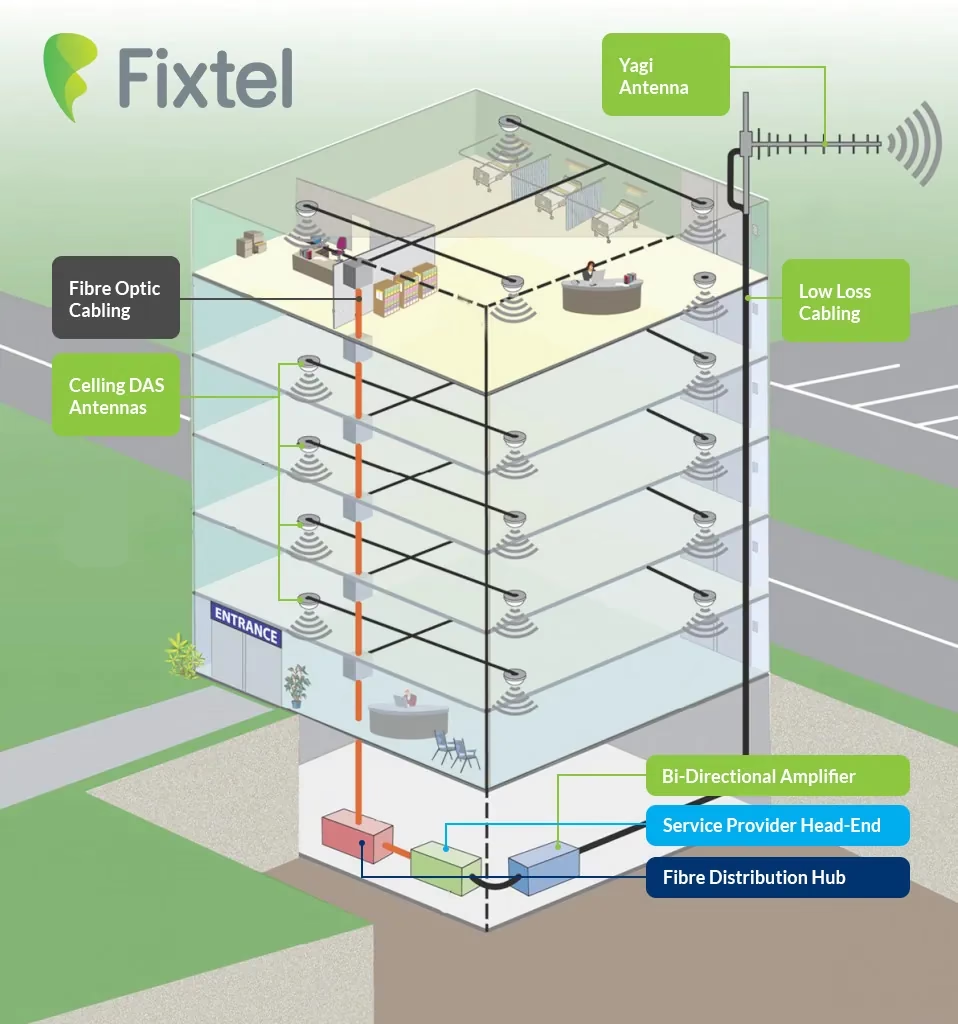
Fixtel’s approach to Active DAS begins with a comprehensive site assessment and walk test. This involves surveying the building to identify existing signal levels on all carrier networks across all floors, car parks, lift shafts, and other problem areas. The walk test data informs the RF design, which determines antenna placement, power levels, and coverage zones, ensuring facilities managers feel confident in a tailored, effective solution.
From RF design to installation and testing, Fixtel’s comprehensive process ensures your building’s Active DAS system is optimised for current and future networks. This approach guarantees reliable coverage, supports 4G and 5G simultaneously, and prepares your building for upcoming 6G technology, making it a strategic investment for your property.
Carrier coordination is a crucial part of the process that building owners sometimes underestimate. Connecting an Active DAS to the Telstra, Optus, or Vodafone networks requires formal approval and technical integration with each carrier. Fixtel manages this process on behalf of building owners, which significantly reduces the administrative complexity involved and reassures developers that the process will be handled professionally.
Ongoing maintenance programs are available to ensure the system continues to perform correctly as carrier networks evolve and building usage changes over time.
Is Your Building Ready for 5G?
The most practical starting point for any building owner or facilities manager is a walk test. This provides a clear, data-driven picture of where coverage is adequate and where it is not across all carriers and frequency bands, including 5G.
If your building has an existing passive DAS, a walk test will confirm whether it is already showing signs of degradation on 5G frequencies, and what the realistic upgrade options are.
If your building has no in-building coverage infrastructure, a walk test identifies the scope of the problem. It allows Fixtel to design a system that solves it in a single installation rather than patching coverage issues reactively over time.
Active DAS is no longer a premium option reserved for airports and large stadiums. It is becoming the baseline expectation for any large commercial building in an Australian city, and the cost of installation is far lower than the cost of dealing with tenant complaints, poor reviews, and lost business over the next decade.
To arrange a walk test or request a quote, contact our team.

